Written by: Ch. Iftikhar Sandhu (Quaid-e-Azam Gold Medalist)
What if the same acre of land could feed far more people? That is the promise of hybrid wheat — and the global race to deliver it has already begun.
⚡ Key Takeaways
- Hybrid wheat is created by cross-pollinating two selected wheat varieties. It is a natural breeding process, not genetic modification.
- Global seed companies Syngenta, BASF and Bayer are racing to bring hybrid wheat to farmers.
- Hybrid corn has been grown since the 1930s. Wheat took longer because of its complexity and cost.
- Pakistan is researching hybrid wheat, but no commercial variety is available to farmers yet.
The world is grappling with a growing population and dwindling agricultural yields. To combat these challenges, global seed giants are racing to develop high-yielding crop varieties. Among these, Syngenta, a Chinese-owned company, is a frontrunner. Very soon, they plan to cultivate a new hybrid wheat variety on 7,000 acres. German companies BASF SE and Bayer AG are also on the verge of introducing their own hybrid wheat varieties.
📌 2026 Update: Syngenta's first limited hybrid wheat release in the United States was planned for about 5,000–7,000 acres. In 2026, the company is preparing the full commercial launch of its hybrid wheat across Europe, including France, the UK and Germany, and reports a yield increase of about 10–12% over conventional varieties.
How is Hybrid Wheat Created? The Science of Hybrid Wheat Breeding
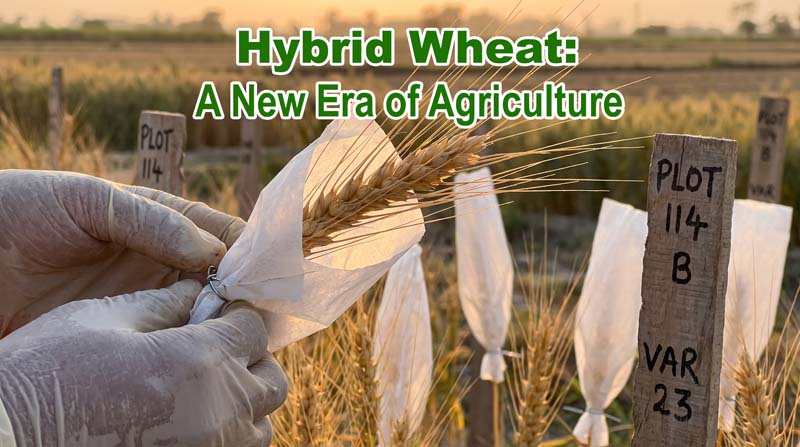
Agricultural researchers create hybrid wheat by manipulating the natural pollination process. Typically, wheat plants pollinate themselves. However, for hybrid wheat, the pollen from one specific variety is used to fertilize another. This cross-pollination results in a new, unique plant with traits from both parent varieties. These hybrids often exhibit higher yields and greater resistance to adverse environmental conditions compared to their parent strains.
The Advantages of Hybrids: Why Farmers Are Watching
The primary advantage of hybrid varieties is the combination of desirable traits from different parent plants. However, a drawback of this method is the lower pollination rate compared to natural pollination. This is because wind-pollinated plants ensure fertilization of all female flowers, while manual or controlled pollination may miss some. Scientists are continuously working to address this issue.
Hybrids in Agriculture: Lessons from Hybrid Corn
Hybrid corn has been cultivated since the 1930s, demonstrating the effectiveness of this technique. Other vegetables, such as onions, spinach, and tomatoes, are also commonly grown as hybrids. The success of hybrid corn, which saw a 600% increase in yield between the 1930s and 1990s, has encouraged research into other hybrid crops.
Why the delay in Hybrid Wheat?
While hybrid corn has been highly successful, the development of hybrid wheat has been slower due to the complexity and cost involved. Unlike genetic modification, which involves altering a plant's DNA, hybridization is a natural process. However, concerns about consumer acceptance, particularly related to potential allergies or health risks, have slowed the commercialization of genetically modified Hybrid Wheat.
Hybrid Wheat in Pakistan: A Coming Revolution
Pakistan is on the way of a hybrid wheat revolution. Researchers from Pakistan and China have made significant progress in developing high-yielding hybrid wheat varieties. The goal is to increase wheat production by 40-50% and reduce the country's reliance on imports. The Pakistan Agricultural Research Council (PARC) is working closely with China to introduce these new varieties.
📌 2026 Update: Pakistan's hybrid wheat research has expanded. The Wheat Research Institute Faisalabad, MNS University of Agriculture Multan and the University of Agriculture Faisalabad are running a joint programme with technical support from Australian experts. Reported yield potential from Pakistan–China research ranges from 20% to 70%. However, researchers note that a commercially viable hybrid wheat variety has not yet been released in Pakistan.
Conclusion: Is Hybrid Wheat the Answer to Food Security?
Hybrid wheat offers a promising solution to the growing global food crisis. By combining desirable traits from different parent plants, hybrid varieties can increase yields, improve resistance to pests and diseases, and enhance overall crop productivity. While there are challenges to overcome, such as the cost of development and consumer concerns, the potential benefits of hybrid wheat are significant.
❓ Frequently Asked Questions About Hybrid Wheat
What is hybrid wheat?
Hybrid wheat is produced by crossing two selected parent wheat varieties, so the new plant combines the strengths of both. It often gives higher yield and better tolerance to difficult conditions.
Is hybrid wheat the same as GMO wheat?
No. Hybridization is a natural breeding process that directs pollination between two varieties. Genetic modification (GMO) involves directly altering a plant's DNA.
How much more yield does hybrid wheat give?
It depends on the variety and conditions. Syngenta reports about 10–12% over conventional varieties, while Pakistan–China research trials have reported a wide range of 20% to 70%.
Can Pakistani farmers grow hybrid wheat this season?
Not yet. As of 2026, no commercial hybrid wheat variety has been released for farmers in Pakistan. For this season, farmers can choose approved high-yield varieties already available.
🌾 Planning Your Wheat Crop This Season?
While hybrid wheat is still on its way, you don't have to wait for higher yields. Rizq 2026 — the new zinc-biofortified wheat variety recently approved by the Punjab Seed Council — offers a yield potential of up to 85 maunds per acre, with rust resistance and drought tolerance.
For seed booking, contact KISANWORLD Marketing Lahore on WhatsApp: 03226780242