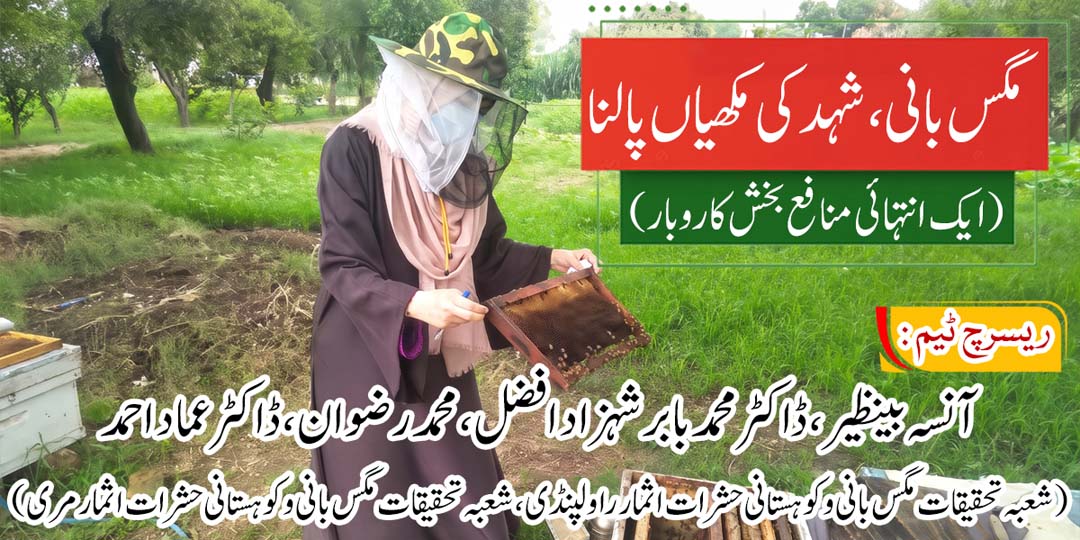
Research Team: Ansa Banazeer, Dr. Muhammad Babar Shahzad Afzal, Muhammad Rizwan, Dr. Ammad Ahmad (Beekeeping & Hill Fruit Pests Research Station Rawalpindi.
Introduction
Honey is one of nature's greatest gifts, serving as both a complete food and a natural medicine. In the Holy Quran (Surah An-Nahl), honey is described as a source of healing for mankind, and modern science continues to validate its remarkable nutritional and medicinal properties. Pakistan is an agricultural country with Punjab serving as its agricultural backbone. Because nectar-rich plants such as mustard (sarson), berseem, sheesham (tahli), kinnow, eucalyptus, sidr (beri), and acacia (phulai) grow abundantly across the province, Punjab offers exceptional potential for organized commercial beekeeping (Magas Bani / Shahad ki Makhiyan Palna).
Nutritional, Medicinal, Agricultural & Economic Importance
Nutritional Importance: Honey is an instant source of natural energy. Its simple sugars—primarily fructose and glucose—are rapidly absorbed by the human body. Approximately 100 grams of pure honey provides around 300 kilocalories of energy. While it is the finest natural alternative to refined white sugar, diabetic patients should consume it only after consulting their physician.
Medicinal Importance: Due to the presence of hydrogen peroxide (generated via the glucose oxidase enzyme), low moisture content, natural acidity, and phenolic compounds, honey possesses potent antibacterial properties. In traditional medicine, it is widely used to treat coughs, sore throats, digestive disorders, and wounds. Its rich antioxidants (flavonoids and phenolic acids) protect the body against oxidative stress.
Agricultural Importance (Crop Pollination): Even beyond honey production, honeybees provide immense value to agriculture through crop pollination. The presence of honeybees significantly boosts yields in kinnow orchards, mustard, sunflower, cotton, vegetables, and fruit orchards. In many crops, the economic benefit of bee pollination exceeds the direct income from honey itself.
Economic & Social Importance: Beekeeping (shahad ki makhiyan palna) can be started with minimal capital and without owning agricultural land, making it a highly profitable livelihood for landless farmers, rural youth, and women. In addition to honey, beekeepers earn supplementary income from beeswax, bee pollen, propolis, royal jelly, and the sale of bee colony units. Pakistani honey—especially Beri (Sidr) and Phulai (Acacia) honey—enjoys high demand across local markets and Gulf countries.

Major Honeybee Species in Pakistan
European Honeybee (Apis mellifera): The most popular commercial honeybee species, reared worldwide in modern movable-frame wooden hives.
Asian Hive Bee (Apis cerana): The northern Asian honeybee, predominantly found in hilly and mountainous regions.
Giant Rock Bee (Apis dorsata): A large wild or cliff-nesting bee whose open single-comb nests cannot be domesticated in wooden boxes.
Dwarf Honeybee (Apis florea): A small wild bee that builds miniature single combs in bushes and hedges.
In Punjab, commercial honey production relies primarily on the European honeybee (Apis mellifera) due to its gentle temperament, lower stinging tendency, high honey yield, and adaptability to wooden hive management.
Major Honey Flora & Seasonal Calendar in Punjab
Thanks to Punjab's diverse climate, honey is harvested throughout the year from sequential floral sources:
Mustard / Sarson & Toria (January – February): Crucial winter flora for rapid bee colony build-up and multiplication.
Berseem / Egyptian Clover (February – April): An excellent spring nectar flow producing light-colored, mild honey.
Kinnow / Citrus Orchards (March): Produces aromatic, delicious citrus blossom honey across Sargodha, Khushab, and adjoining districts.
Phulai / Acacia modesta (March – April): Produces famous, premium-grade honey in the Pothohar region, Salt Range, and Chakwal.
Sheesham / Tahli (Spring): An important arboreal nectar source across Punjab during the spring season.
Beri / Ziziphus Jujube (September – October): Produces the most expensive and sought-after Sidr/Beri honey in Punjab and Khyber Pakhtunkhwa.
Sunflower, Cotton & Other Crops: Provide valuable seasonal nectar flows in their respective growing zones.
Migratory Beekeeping: Many commercial beekeepers in Punjab load their wooden hives onto trucks and migrate seasonally—moving to Central Punjab for mustard, Pothohar and the Salt Range for Phulai, and Southern Punjab or Sindh during winter. This migratory schedule maximizes annual honey output and maintains strong, healthy colonies.
Chemical Composition & Natural Crystallization of Honey
Honey is primarily a supersaturated solution of natural sugars and water, enriched with hundreds of trace bioactive compounds (exact percentages vary by floral source and season):
Water (Moisture): 15% to 20%
Fructose: 35% to 40%
Glucose: 28% to 35%
Sucrose: 1% to 5%
Maltose & Other Sugars: 5% to 10%
Proteins & Amino Acids: 0.2% to 0.5%
Organic Acids (such as Gluconic Acid): 0.2% to 0.5%
Minerals (Potassium, Calcium, Magnesium, Iron): 0.1% to 0.5%
Enzymes (Invertase, Diastase, Glucose Oxidase), Phenolics, Flavonoids & Vitamins: Present in trace amounts
Physical Characteristics: Honey has a natural pH of approximately 3.4 to 6.1, with viscosity determined by moisture and temperature. Its color ranges from pale golden (Berseem and Kinnow) to dark amber (Eucalyptus and Beri).
Why Pure Honey Crystallizes (Granulation): The solidification or crystallization of honey in winter is a 100% natural physical process—especially in mustard (sarson) honey where the glucose-to-fructose ratio is high. Granulation does not indicate adulteration; believing that crystallized honey is fake is a common misconception.

International Quality & Export Standards
The globally recognized benchmark for honey is the Codex Alimentarius Standard 12-1981, which defines strict quality parameters:
Moisture Content: Maximum 20%
Reducing Sugars (Fructose + Glucose): Minimum 60 g per 100 g
Sucrose: Maximum 5 g per 100 g
Water-Insoluble Solids: Maximum 0.1 g per 100 g
Hydroxymethylfurfural (HMF): Maximum 40 mg/kg (up to 80 mg/kg for tropical/warm regions)
Diastase Activity: Minimum 8 Schade units (3 for certain low-enzyme honeys)
Free Acidity: Maximum 50 milliequivalents per kg
Electrical Conductivity: Typically up to 0.8 mS/cm for blossom honeys
Adulteration & Export Compliance
A major challenge in Pakistan's honey sector is adulteration—such as mixing sugar syrup, commercial glucose, or corn syrup, or harvesting unripe honey prematurely (resulting in excessive moisture). Household tests (dropping honey in water or burning it on a matchstick) are scientifically unreliable; accurate verification requires laboratory testing (Moisture, HMF, Diastase, Sucrose, Carbon Isotope Analysis, and NMR). For export to the European Union and Gulf markets, honey must be free from antibiotic residues (such as chloramphenicol and tetracyclines), pesticides, and heavy metals, with full farm-to-jar traceability.
Fundamental Principles of Modern Colony Management
The Hive (Langstroth Hive): Commercial beekeepers in Punjab use the standard Langstroth wooden hive, consisting of a bottom board, brood chamber, honey supers, movable wooden frames, and inner/outer covers. Movable frames allow inspection and centrifugal honey extraction without destroying the wax comb.
The Queen Bee: Each colony has one fertile queen, thousands of worker bees, and seasonal drones. Re-queening every 1 to 2 years maintains high egg-laying vigor and honey yield.
Apiary Site Selection: Choose a shaded, well-ventilated location near clean running water and away from fields undergoing heavy chemical pesticide spraying.
Supplemental Feeding & Seasonal Care: During floral dearth periods—such as extreme summer heat (May–June) and post-monsoon—colonies require sugar syrup and pollen substitutes. Provide shade and clean water in summer, and wind protection in winter.
Diseases & Pests: Regularly inspect colonies for Varroa destructor mites, Nosema, European and American Foulbrood, Wax Moth, hornets, and ants. Never apply synthetic chemicals while honey supers are mounted on the hive to prevent chemical residues in honey.
Step-by-Step Honey Extraction Process (9 Stages)
Stage 1 — Assessing Ripeness & Harvest Timing: Harvest only when 80% or more of the honeycomb cells on a frame are sealed with white wax cappings, indicating mature honey with proper moisture. Unripe honey (uncapped cells) contains excess moisture and ferments easily. Harvest on a warm, sunny morning or late afternoon when bees are calm.
Stage 2 — Protective Gear & Hygiene: Wear a bee veil, gloves, protective suit, and use a smoker and hive tool. Maintain strict hygiene using clean, food-grade stainless steel equipment.
Stage 3 — Removing Bees from Frames: Apply gentle smoke to calm the colony, then shake frames gently or sweep bees off using a soft bee brush (or a bee escape board/blower). Cover harvested frames immediately to prevent robbing by other bees.
Stage 4 — Uncapping the Honeycomb: Carefully slice off the wax cappings using a heated uncapping knife, uncapping fork, or electric knife. Collect the wax cappings separately to recover pure beeswax and residual honey.
Stage 5 — Centrifugal Extraction: Place uncapped frames inside a manual or electric stainless-steel honey extractor. Spin gently at first and then increase speed so honey flows out without breaking the wax comb. Return the intact empty frames to the hive to save the bees' energy and wax.
Stage 6 — Straining & Settling: Pass the extracted honey through a double strainer (coarse and fine nylon or stainless-steel mesh) to remove wax particles and debris. Let the honey rest in a settling tank for 24 to 48 hours so air bubbles rise to the top and can be skimmed off.
Stage 7 — Quality & Moisture Testing: Measure moisture using a honey refractometer to ensure it is below 20%, and evaluate color, aroma, flavor, and clarity. High-moisture honey can be treated in a controlled dehumidification room.
Stage 8 — Bottling, Labeling & Storage: Pack honey in clean, dry glass or food-grade plastic jars labeled with floral source, net weight, packing date, and producer details. Store in a cool, dry, dark place away from sunlight. Avoid heating honey above 40°C to preserve natural enzymes and prevent HMF elevation, and never store honey in rusty metal containers.
Stage 9 — Post-Harvest Colony Care: Return empty frames to the hives, check food stores, and inspect for Varroa mites and diseases so colonies remain strong for the next nectar flow.
Opportunities, Challenges & Recommendations for Punjab
Key Challenges
Adulteration and lack of consumer trust in market honey
Indiscriminate pesticide spraying during crop flowering, causing bee mortality
Nectar dearth during extreme summer months
Varroa mite infestations and shortage of trained beekeeping technicians
Limited access to modern honey testing laboratories, processing units, and GI branding
Climate change, heatwaves, and erratic rainfall disrupting blooming cycles
Expert Recommendations
Provide scientific hands-on training to beekeepers across Punjab.
Expand the network and accessibility of accredited honey testing laboratories.
Educate farmers on bee-safe pesticide application (avoiding sprays during blooming and spraying only in the evening).
Establish Geographical Indication (GI) tagging and international branding for Pakistani Phulai and Beri honey.
Promote beekeeper cooperatives for collective collection, processing, and export marketing.
Include nectar-producing trees (Sheesham, Beri, Phulai) in national and provincial afforestation campaigns.
Conclusion
Honey is not merely a sweet food—it is a vital pillar of nutrition, public health, crop pollination, and rural economy. By combining scientific hive management, strict quality control, zero adulteration, and modern branding, Pakistan can fulfill domestic demand and earn substantial foreign exchange through premium honey exports.
Search Keywords (Roman Urdu & English)
shahad ki makhiyan palna | magas bani in pakistan | beekeeping business in pakistan | honey farming in punjab | beri ka shahad | phulai honey pakistan | khalis shahad ki pehchan | apis mellifera pakistan | langstroth hive box | shahad nikalne ka tariqa | honey bee pollination | kisan world magazine