Kisanworld September 2026
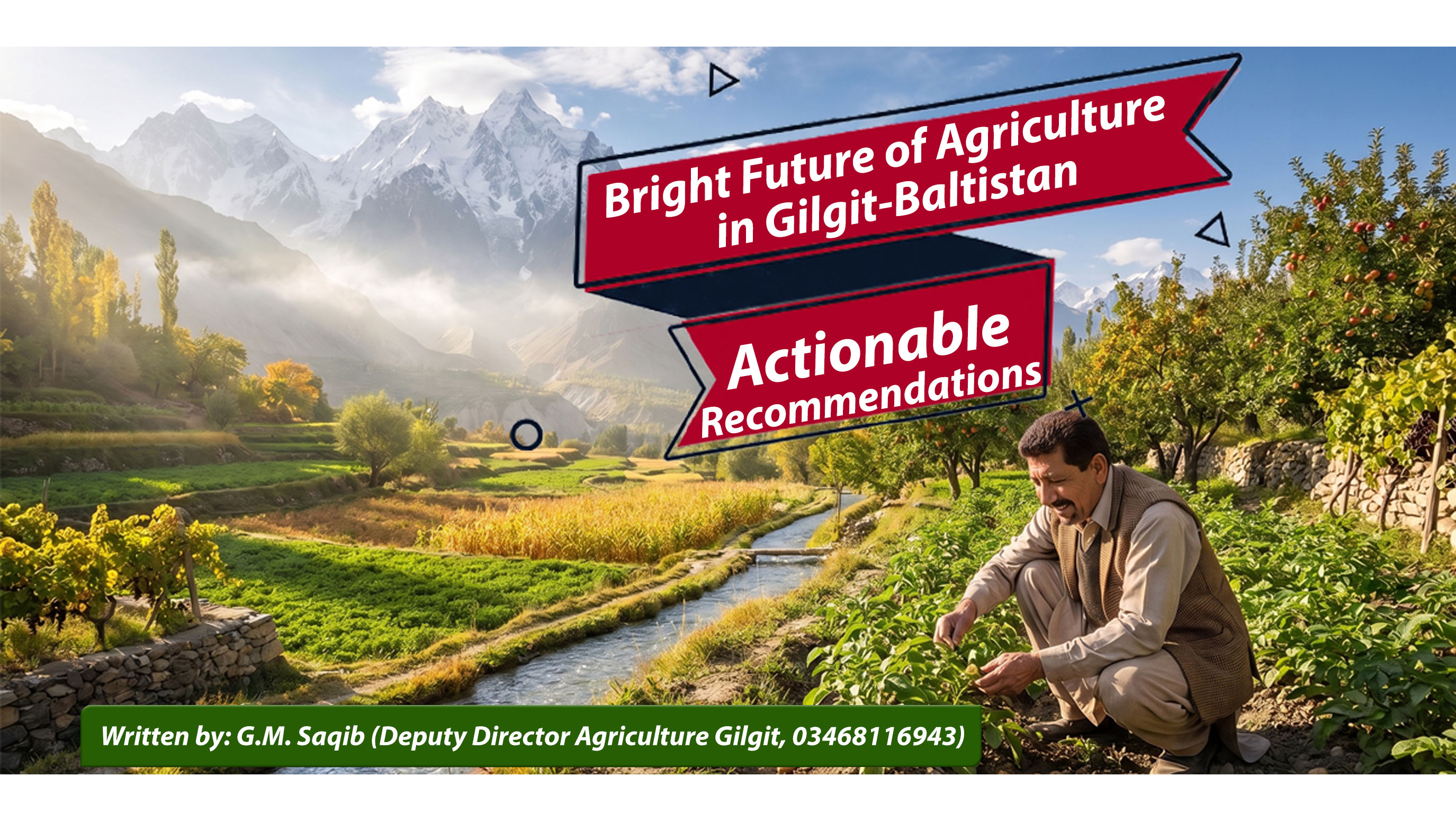
Bright Future of Agriculture in Gilgit-Baltistan
(Actionable Recommendations)
Written by: G.M. Saqib (Deputy Director Agriculture Gilgit, Mobile: 03468116943)
Gilgit-Baltistan is a rare gift of nature. Snow-capped mountains, crystal-clear water from glaciers, clean environment, fertile valleys and unique climatic conditions are agricultural resources that very few regions of the world possess. This is why agriculture in Gilgit-Baltistan is not conventional farming but a special system that requires separate policy, separate research, separate investment and a distinct development strategy.
Unfortunately, over the past several decades, agriculture has never become the primary priority of governments. A large share of the development budget continued to be spent on other sectors, while the sector to which the majority of the rural population is attached was continuously neglected. As a result, farmer incomes remained limited, youth moved away from agriculture and the agricultural economy could not reach its true potential.
The reality is that if poverty is to be reduced in Gilgit-Baltistan, employment opportunities created for youth, women economically empowered, food security ensured and the rural economy strengthened — then the most effective path is the integrated development of agriculture, horticulture, livestock, fisheries, value addition and agro-tourism.
A welcome development today is that both the Chief Minister and the Agriculture Minister of Gilgit-Baltistan come from agricultural and rural backgrounds and are well aware of farmers' problems and the importance of the agricultural economy. Similarly, the Secretary of Agriculture, Livestock and Fisheries Gilgit-Baltistan is himself an agricultural graduate who understands the technical needs and modern requirements of this sector. Current conditions therefore provide a golden opportunity to make agriculture a genuine top priority of the development agenda and launch an effective, fast-paced and results-based reform programme.
For this purpose, it is essential that an empowered Gilgit-Baltistan Agriculture Task Force be established under the direct supervision of the Chief Minister and headed by the Secretary of Agriculture, comprising the Agriculture Department, Livestock, Fisheries, universities, private sector, development organizations and successful farmers. This task force should be given adequate financial resources, clear targets and a three-year Agricultural Crash Programme so that significant results can be achieved in a short period. This programme should not be limited to traditional crops but should lay the foundation for modern, profitable and climate-smart agriculture.
Key Recommendations:
Vertical Farming and Greenhouse Technology should be promoted first so that several times more production and income can be obtained from limited land. In mountainous areas, this model can prove extremely suitable for small farmers.
Japan's successful One Village One Product model should be introduced in Gilgit-Baltistan so that each village establishes its unique agricultural or value-added product identity and the local economy is strengthened.
Agro-Tourism has been made an effective means of rural prosperity by several countries, especially China and Thailand. In Gilgit-Baltistan too, farmers' incomes can be significantly increased by promoting model farms, farm stays, farmer markets, farm cafes, fruit picking activities and agricultural fairs.
Floriculture should be developed as a new industry. World-class tulip gardens, cut flower farms and commercial production of lilium, gladiolus, China aster, gerbera and other commercial flowers should be promoted in Gilgit-Baltistan. If large tulip gardens are established on the lines of Srinagar, they could open new avenues not only for tourism but also for the local economy.
Seed Production should be made the fundamental pillar of agricultural development. Local production of standard and hybrid seeds of potato, vegetables and flowers will reduce farmers' costs and Gilgit-Baltistan can become an important seed production zone at the national level.
Commercial Mushroom Culture, Sericulture (silk production), Medicinal and Aromatic Plants cultivation and export production of fragrant herbs should be promoted through special programmes.
Value Addition is essential for complete agricultural development. Home-based and cottage industries for producing jam, jelly, juice, dried fruits, herbal tea, natural cosmetics and food products from apricot, cherry, apple, mulberry, grapes and other fruits should be provided with modern machinery, training and marketing facilities.
Off-season vegetable cultivation, tunnel farming and climate-smart agriculture should be expanded so that farmers can earn income throughout the year. Vermicompost, organic farming and natural agricultural systems should be promoted to introduce Gilgit-Baltistan as an organic agriculture brand.
Horticulture also requires fresh thinking. Modern and long-lasting varieties should be introduced to increase production, quality and market value. Particularly, by introducing early, mid and late-ripening varieties of cherry, the cherry season can be extended from one month to approximately two months. Similarly, commercial cultivation of blueberry, kiwi fruit, modern drying-suitable fig varieties, high-quality grapes, walnuts, almonds and other high-value and minor fruits should be promoted.
Food Security must never be neglected. Priority should be given to provision of certified seeds of wheat, barley, corn, buckwheat and foxtail millet, modern agricultural advisory, effective irrigation systems and climate change-responsive agricultural research to make the region further food secure.
Conclusion:
If the government, agriculture department, universities, private sector, development partners and farmers work together with a clear vision, adequate funds are provided and the 3-year Agricultural Crash Programme is implemented seriously — then Gilgit-Baltistan can become not only Pakistan's most successful high-value, climate-smart, organic and agro-tourism-based agricultural region but also an exemplary model for Central and South Asia.
The time has come to recognize agriculture not merely as a department but as the fundamental pillar of Gilgit-Baltistan's economy, rural prosperity, food security and sustainable development. If correct decisions are made today, coming generations will inherit a prosperous, self-sufficient and agriculturally strong Gilgit-Baltistan.